Girl Talk
Girl Talk
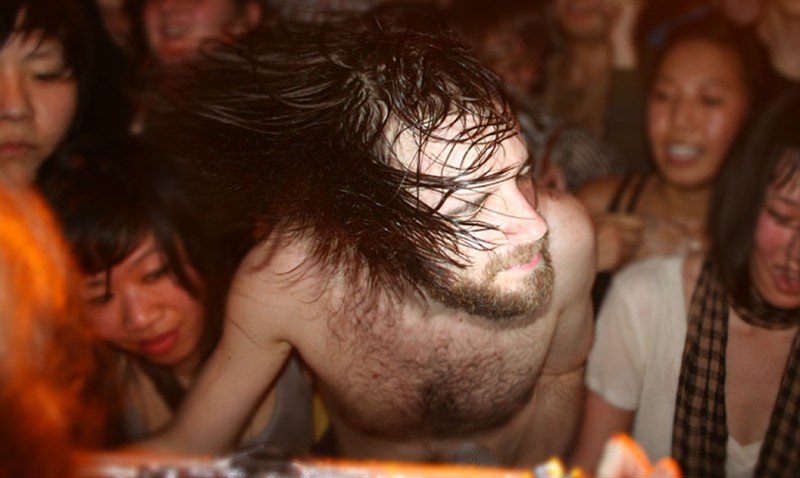
How hard is for Gregg to keep his shirt on? Found out here!
By: Mark Steffen

There’s no way that you haven’t heard Girl Talk’s new album, Feed the Animals. That is, if you haven’t been living under a soundproof shield of bad ‘80s music, then you’ve definitely heard at least part of the mix master Gregg Gillis’s opus. While you can still download the entire album for a price of your choice, you can also pick up the physical album these days.

But, if you want to help out the Pittsburgh native even more, catch him on tour in the coming months. With dates in all the major hotspots, it should be more than easy to catch his concerts-turned-dance-parties; even if you’re living in a place like Urbana, IL.

We caught up with the shaggy-haired jive master for a few minutes to talk about why he’s playing Urbana, how he’s made a living on copyrighted material and, most importantly, where he’s partying lately and whether or not he’ll be taking his shirt off.

HEAVE: I see you just wrapped up playing almost every big party this summer and you’ve got a month off before your own tour begins. What have you been doing with all the new free time?

Gregg Gillis: Aw man, dude, I haven’t had any free time so far. It’s been, uh, it’s been a lot of traveling. Pretty much since the album came out it’s been non-stop traveling. Yeah, and I just kind of moved into a new place in Pittsburgh so every free moment I have has been moving boxes around and trying to organize CDs and boring stuff like that. So I’m actually going out to a party tonight in Pittsburgh for, like, the first time in a very long time.

HEAVE: Are you DJ’ing or letting someone else take the helm on that one?

GG: (laughs) No way, man, I’m just gonna be the drunkest guy there.

HEAVE: Now I first saw you about a year and a half ago in L.A. and you referred to the city that night as “The Pittsburgh of L.A.” I guess the next question would be is it good to be home? You’ve been all over the place.

GG: I might’ve been a little facetious there, but, uh, it’s a great spot. But Pittsburgh is a great spot; a very differing spot. I love it; it’s a very interesting, cool spot with a lot of very approachable people. I like hanging out here ‘cause I’m traveling so much… lots of times when I’m traveling, it’s to parties where there’s lots of free alcohol hanging around and things like that, so when I get home I usually have the opposite of that. I sit and watch movies and, y’know, work on music. And drink lots of Gatorade to replace all the electrolytes I lose.

HEAVE: I noticed you skipped playing Chicago and a couple of other large cities with this tour. Is that something that you had to do in order to play the big dates over the summer?

GG: Well, a lot of times, with the festivals, they have a contract that says they don’t want you to play in or around there for 3 months or something like that. So, pretty much, one of the few people I work with in terms of business is a booking agent who is actually based in Chicago. He has a pretty good game plan for getting around everywhere as efficiently as possible. So pretty much, it means that if I miss a place during a tour, then most likely it means I’ll be going there either before the tour, after it, whatever. A lot of times you can substitute festival shows in for your own tour dates. Especially trying to fit in Australia and European dates. It’s tough to get everywhere every year. But yeah, we kind of do that, but usually if I am missing something, it’s never on purpose. It’s usually cause I’m planning on coming soon.

Editor’s Note: A Chicago show was added shortly after this interview.

HEAVE: I do have to warn you, I saw you’re playing a show in Urbana, Illinois, where I went to undergrad. You’re gonna have quite a good time. Those kids get rowdy.

GG: I’ve never been through there… nice. I’m slowly kind of knocking off most major cities and it’s weird to go to a place I’ve never been to, so it’ll be a first. I’m really excited.

HEAVE: Now, you’re one of the only people in history to make a career on material that you haven’t “officially,” in a legal sense, created. Have you experienced any backlash about what you’re doing?

GG: Um, no. Not from artists. The whole idea is controversial to some people - that you can exist as an actor or artist where it’s primarily based on samples from other people. From the source material, I’ve had no issues, no one has reached out. We’ve had no legal problems. If it gets to a point where someone does have a major issue, then you might hear about some kind of confrontation. But, at this point, we’ve had no problems so far.

HEAVE: That’s excellent. Do you have any idea what you’d do if something did happen? I’m sure it’s one thing if Metallica comes after you and a completely different thing if Bono wants to sit down and talk about things. Are you taking them head on or will you just quit playing that sample at your shows?

GG: No, I mean, I believe in the doctrine in the United States called Fair Use that allows you to sample things up without asking permission as long as the work is transformative and it doesn’t impact the original artist’s sales. I mean, it’s not like I’m releasing this music renegade style, just throwing caution to the wind, nothing like that. There is a legal basis behind it and there’s actually a big academic and legal push for more free exchange of culture, especially in the digital age. So yeah, I mean, if someone were to approach us and have a problem with it, we would definitely defend ourselves under a Fair Use claim. There’s even been a politician like Mike Doyle, a congressman from Pennsylvania, who has backed me up in public a few times. Various people like that, legal professors and people like that. It’s not like what we’re doing is completely illegal and they haven’t found out about it yet. It’s a gray area and if we were to go to court we’d definitely stand up and defend our side of the argument.

HEAVE: That’s great. It’s good to have people not only making art as well as you do, but being willing to go to court and back it up. Y’know, especially doing it well enough that people haven’t taken you there.

GG: Yeah, sampling is definitely still a new tool and people still hold on to these old ideas that there’s “intellectual property” and “idea ownership” based on rules that were set in stone a hundred years ago. Things are changing very rapidly. Especially with TV dying out and digital music becoming so huge right now. I think everyone is starting to learn to interact with the media rather than just consume it. I think the industry is gonna have to learn to change with it as well.

HEAVE: When I first heard Feed The Animals, it seemed completely different than Night Ripper. Not just because you were using longer samples, but it felt a lot denser and the tracks seemed to stand alone a lot better. Was that something that came about because of what happened on the dance floor or was it a more personal thing where you went into it thinking that you wanted to create something that stood alone, that you didn’t have to play one track into another in order for it to make sense? It feels so much funkier than Night Ripper.

GG: I definitely thought of the whole album as one continuous track, but when you’re using bigger samples it allows the track separations to be easier. Y’know what I mean? If you’re going through a thousand samples at once then any separation is going to sound kind of random. I think that’s why the tracks have more distinct beginning and ends. I think on this record separating tracks was an afterthought. With this one I just put everything down and figured out afterwards where the separations would be. I spent a lot more time on it. With Night Ripper I kind of just picked random points to some degree, y’know. Picked places where things would just make sense.

With Feed The Animals, I actually spent a solid day or two afterwards just finding logical beginnings and ends and working with them. But as far as a vision or an aesthetic direction for the album, now that I’ve finished it I feel the exact same way as I did when I finished Night Ripper. I’d spent so long assembling this album and you don’t know where you’re gonna go from there. Then you start working on even more new material and there’s no conscious decision on a particular direction. And, as you were saying in the question, it naturally evolved from both what I saw at shows and my own interest in music. With Night Ripper, I almost wanted to make a statement or almost separate myself from all the traditional mash-up artists and I wanted to make something that was very technically challenging. I wanted to make it fun as well, but the technical aspect was definitely focused on. So once I did that, I thought there was not much left to prove with that. I proved I could do an album that people could have fun with and that had 300 plus samples in it.

So on the new one, I thought I should focus a little less on the technical and more on the musical side of things. You could have taken it in a variety of directions. I could have chopped up more samples and made it more over the top in that direction or I could have made something that’s more musical and more accessible. And that’s what I wanted to do. And I think, as the years go on, I get better at what I do. So I think the denseness of it is something from getting a lot more comfortable with my own production. I was able to create a lot more layers and there’s a lot more subtle elements going in and out there than there were on Night Ripper. So yeah, it was kind of a natural evolution from the live show. Once I stepped out to do the album I basically looked back at what I’d been doing with the shows and it was definitely something where I was not as hurried to rush through material, so I wanted to capture that on the album.

HEAVE: It sounds like you went about it in the same way that any traditional rock band goes about creating a concept album. You write the whole thing, then you figure out where the breaks should be at that point. You get the whole idea out and then turn it into an album afterwards.

GG: Yeah, and it’s a continually evolving thing. Certain parts that naturally go next to each other are there because they naturally went next to each other during sets. It’s hard to explain, but I could never just sit down and figure it out. I just kind of take a little bit of time and work with it and kind of figure out… almost the last thing I do is figure out how I’m going to create a synopsis of everything that’s been going on.

HEAVE: Whose idea was it for the digital downloading and pay-what-you-will structure? And have you been pleased with the way that’s worked out for the album?

GG: That was, y’know the label that puts out my stuff, Illegal Art, that was their idea initially. I wasn’t even thinking about it, but once they threw it out there as an option to me, I wanted to do it. Everything’s been going good. Sales have been good. Obviously more people are going to download it for free than pay for it but, for me, the big goal was, “How can we go about releasing this album as quickly as possible, as efficiently as possible and getting it out there in a high quality form?” I hate when there’s really shitty sounding MP3’s all over the internet, that’s always annoying to me. I just wanted to get it out there to people in the easiest way that you can. I think doing it this way got it out there very efficiently. For me, record sales just aren’t that big of an issue. Actually I want as many people to hear it as possible. Basically, as far as the financial end of things, I make a living off of playing shows. So every single person who downloads it for free, I mean, that’s cool with me. Then more people are getting turned on to it and more people are coming out to shows. It just expands the audience so I think… I think more people heard it than if would’ve heard it if we just made people straight-up pay for MP3’s. So I basically can’t argue with that. It’s definitely the direction that I want to go.

HEAVE: Excellent - one last question. Do you have any plans to stop ripping off your shirt and dumping beer on innocent bystanders?

GG: (Laughs) I don’t ever plan on stopping that, but slowly I’ve become less dependent on it. For a little while it was a crutch. At the club shows, y’know, it’s usually so hot that it’s ridiculous for me to keep my shirt on. Sometimes I’m just dying up there. I did notice that, I played last weekend at All Points West and the weekend before at Lollapalooza, for both of those I kept my shirt on for about 99% of the show. So I’ve noticed if it’s cool and there’s air blowing through my hair and cooling me down then I’m less dependent on it.

HEAVE: Cool, well thanks for taking the time to talk with us. Good talking and thanks for your time.

GG: No problem, man.


Discuss
Jake
left on Aug 25, 2008
I tell my friends that he is like a fireworks show. You've seen one set and you've seen them all.


RECENT

Nov 5, 2008 The Detroit Cobras
The Detroit Cobras
Rachel Nagy talks about performing live, songs that keep her awake and wanting a pony.

Oct 27, 2008 Matt & Kim
Matt & Kim
Help Matt & Kim pick out a Halloween costume!

Oct 13, 2008 Black Kids
Black Kids
Kevin Snow talks iTunes, giving away music for free and chode rock

Sep 22, 2008 John Moen
Perhapst
John Moen talks Decemberists, Stephen Malkmus and his horrible blogging skills.

Sep 15, 2008 Koufax
Koufax
Rob Suchan talks Strugglers, politics and the Koufax Book Club